Order leakageImaging staff
CT and MRI contrast: types, screening and prior auth
Iodinated vs gadolinium contrast, what to ask before a contrast exam, and how one questionnaire keeps self-scheduling, billing and prior auth right.
Published By Yashaswini Lagadapati
Contrast is a drug given before or during an imaging exam so blood vessels and tissue stand out. CT and X-ray use iodinated contrast; MRI uses gadolinium-based contrast. Each exam comes without contrast, with it, or both, and each version has its own code, so a screening questionnaire answered at booking keeps the exam, authorization and claim in step.
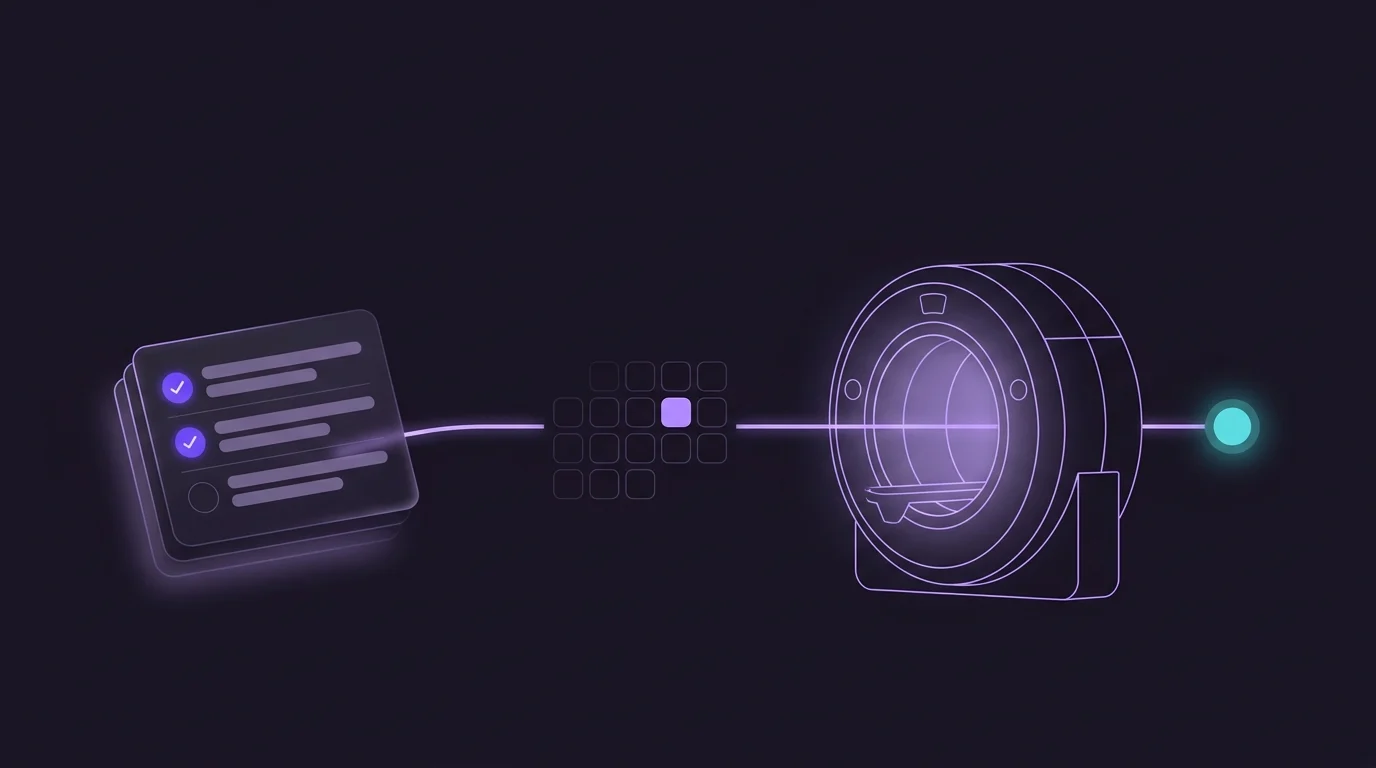 Watch it in under a minute
Transcript
CT and MRI contrast in under a minute.
Contrast is a drug that makes vessels and tissue stand out.
CT uses iodinated contrast.
MRI uses gadolinium.
Most exams come three ways: without contrast, with it, or both.
Each one is a different exam to book, authorize and bill.
Gravity settles the version when the order arrives
and flags anything that isn't right for a person to resolve.
The patient answers the contrast questions once, as they book,
and their answers steer which slots are offered.
Slots too early for the authorization are greyed out.
Coverage and authorization are fixed before the exam,
not discovered after the claim.
One questionnaire keeps the exam, the authorization and the claim in step.
Learn more by visiting alphanodus.com.
Contrast in one minute
What it is: a drug that makes blood vessels, organs and abnormal tissue stand out on the images.
The two you will see most: iodinated contrast for CT and X-ray, and gadolinium-based contrast for MRI.
Why operations care: every exam comes in up to three versions, without contrast, with contrast, and without then with, and each version is a different exam to book, authorize and bill.
Where the order leaks: the patient who needed labs and didn't get them, the slot that was too short, the authorization for the wrong version, the exam moved because the payer wasn't ready.
What fixes it: one screening questionnaire, tied to the exam and answered before the patient is booked, and the version settled before anyone books, authorizes or bills it.
What is contrast in medical imaging?
Contrast media, often called contrast dye, are drugs given to a patient so that structures with similar density or signal look different on the images. A blood vessel, a tumor and the healthy tissue around it can look almost the same on a plain scan. With contrast, the radiologist can tell them apart.
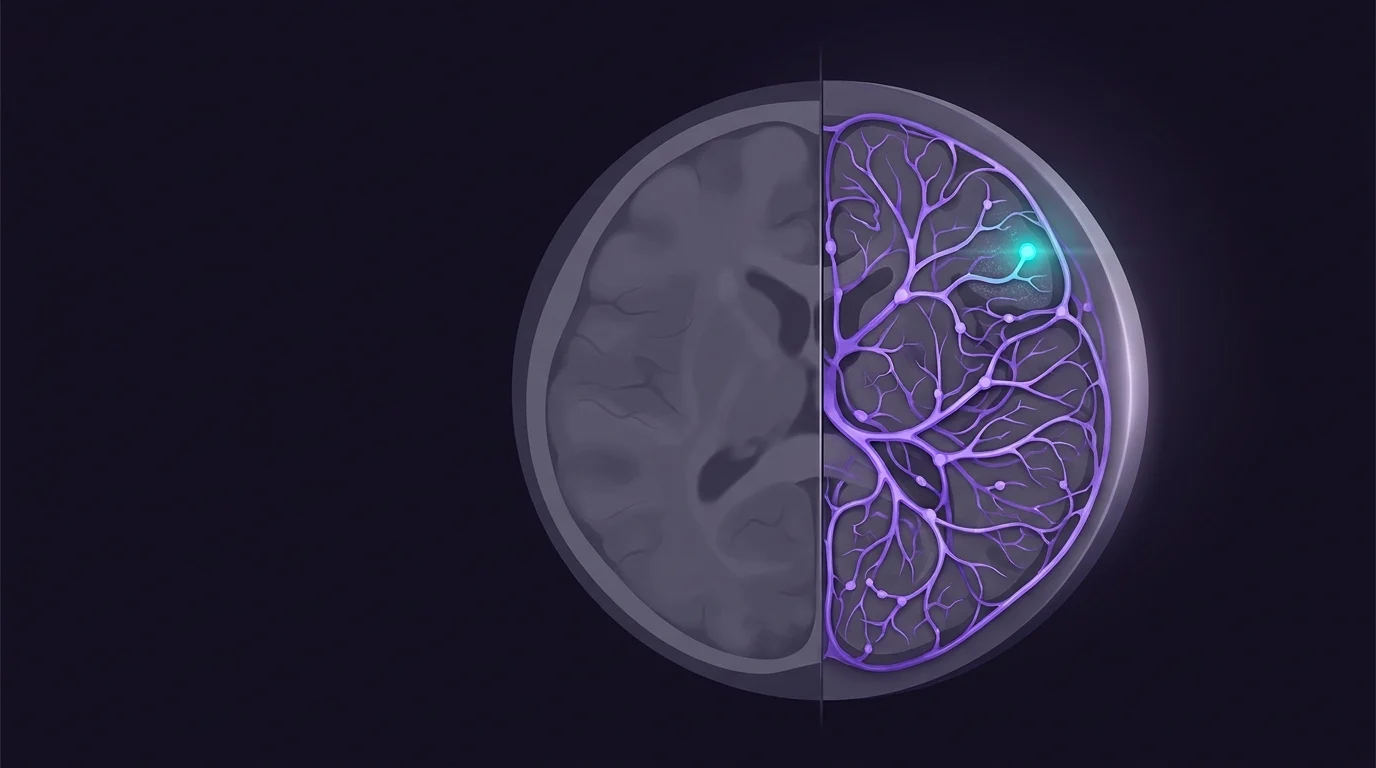
The same slice without contrast (left) and with contrast (right): vessels and enhancing tissue stand out.
Contrast is given by vein (intravenous, IV), by mouth (oral), rectally, into a joint (intra-articular) or into the spinal canal (intrathecal), depending on the exam. Most contrast leaves the body through the kidneys within a day, which is why kidney function comes up so often in screening.
Radiotracers used in nuclear medicine and PET, such as FDG, are not contrast. They are radioactive drugs with their own preparation and safety rules, and they are booked and screened separately.
What types of contrast are there?
Iodinated contrast (CT, fluoroscopy and angiography). Iodine blocks X-rays, so tissue that takes up the contrast shows bright on a CT scan. Modern IV agents are low-osmolality or iso-osmolality nonionic drugs. Iodinated contrast is used for CT of the chest, abdomen and pelvis, CT angiography, fluoroscopy and catheter angiography.
Oral and rectal contrast (CT of the abdomen and pelvis, fluoroscopy). A dilute iodinated drink, or barium sulfate, fills the bowel so it can be told apart from the organs around it. The patient usually drinks it over an hour or more before the scan, which affects arrival time and the length of the visit.
Gadolinium-based contrast agents, GBCAs (MRI and MR angiography). Gadolinium changes how nearby tissue behaves in the magnetic field, which makes enhancing tissue stand out. Agents differ in molecular structure (linear or macrocyclic), and the American College of Radiology (ACR) groups them by their risk of nephrogenic systemic fibrosis (NSF), a rare condition seen in patients with severe kidney disease. The ACR's group II agents carry the lowest risk, and most centers now use them.
Ultrasound contrast (contrast-enhanced ultrasound, CEUS). Microbubbles of gas in a shell, given by IV, show blood flow. They are used in echocardiography, liver imaging and some pediatric bladder studies. They contain no iodine or gadolinium, and the kidneys do not clear them.
Contrast in a joint or the spine (arthrograms and myelograms). For an arthrogram, iodinated contrast is injected under fluoroscopy to confirm the needle is in the joint; for an MR arthrogram, dilute gadolinium is injected too, and the patient goes to MRI. A myelogram uses iodinated contrast approved for the spinal canal. These are two-step visits, often across two rooms, and they are booked as one.
With, without, or with and without: why the version matters
Most CT and MRI exams have three versions, and each has its own CPT code. Two common examples:
CT abdomen and pelvis: 74176 without contrast, 74177 with contrast, 74178 without contrast followed by with contrast.
MRI brain: 70551 without contrast, 70552 with contrast, 70553 without contrast followed by with contrast.
The version changes four things at once:
The screening: a contrast version needs the contrast questions; a non-contrast version doesn't.
The slot: an IV start, oral contrast or a second set of images takes time, so a with-and-without exam needs a longer slot than a without exam.
The authorization: payers authorize a specific code, so the authorization has to be for the version that will be done.
The charge: the exam code, and in many settings a separate supply code for the agent, have to match what happened in the room.
The order sometimes says one version and the radiologist protocols another. Settling the version before booking, not at the scanner, is what keeps all four in step.
In Gravity: the version is settled when the order arrives. Gravity's order appropriateness check runs as soon as an order is received: an agent checks that the exam ordered is appropriate and correct for the patient, and flags anything that isn't for a person to resolve. Each device then lists the exams it performs and how long each takes there, so a with-and-without exam is offered only in a slot long enough to do it, and an arthrogram's injection and its MRI are booked as one visit, in the right order.
Who needs extra screening before contrast?
Screening finds the small number of patients who need a lab test, a different agent, premedication or a radiologist's review. The thresholds belong to the center's supervising radiologist; the ACR Manual on Contrast Media is the reference most US centers use. Clinical guidance changes, so confirm current guidance with your radiologist before you build or change a questionnaire.
Before iodinated contrast:
A prior reaction to contrast. The strongest predictor of a future reaction. The patient may be given a different agent or premedicated under the radiologist's protocol, which has to start hours before the exam.
Kidney function. ACR and National Kidney Foundation consensus puts the main risk in patients with an eGFR below 30 or acute kidney injury. A questionnaire decides who needs a recent eGFR: commonly age over 60, kidney disease, dialysis, a kidney transplant or a single kidney, kidney cancer or surgery, diabetes, and hypertension treated with medication.
Metformin. Under ACR guidance, patients with acute kidney injury or an eGFR below 30 stop metformin at the time of contrast and for 48 hours after. Other patients usually need not stop.
Thyroid. Iodine can interfere with radioactive iodine treatment and thyroid scans for weeks after the exam, so a planned thyroid treatment or scan is worth asking about.
Pregnancy and breastfeeding. Iodinated contrast can be given in pregnancy when the exam needs it. The ACR does not require breastfeeding to stop.
Asthma and serious allergies. These raise the chance of a reaction and are part of the radiologist's review.
Before gadolinium-based contrast:
Dialysis, severe kidney disease or acute kidney injury. These are the patients in whom NSF was seen. With group II agents the risk is very low, and ACR guidance makes routine eGFR testing optional, but the center's protocol decides.
A prior reaction to gadolinium. Handled like an iodinated reaction: a different agent or premedication, under the radiologist's protocol.
Pregnancy. Gadolinium is generally avoided in pregnancy unless the exam's benefit clearly outweighs the risk.
Repeated doses. Small amounts of gadolinium stay in the body, and the FDA requires patients to receive a Medication Guide. No harm has been shown, but some patients will ask.
MRI safety screening, for implants, devices and metal, is separate from contrast screening. A patient booked for a contrast MRI needs both.
How do you build a contrast screening questionnaire?
A paper form at the front desk finds the problem when the patient is already in the building. A questionnaire answered at booking finds it while there is still time to order labs, start premedication or book a longer slot. Five rules make one work:
Tie it to the exam. Attach the contrast questions to the contrast versions only. A patient booked for a non-contrast CT should never see them.
Ask once, show only what applies. Branch the questions: the metformin question follows a yes to diabetes, the pregnancy question follows the patient's age and sex. Keep the answers on the patient, and confirm them at check-in.
Give every answer an action. Agree with the radiologist what each answer does: proceed, require a lab result within a set number of days, add time to the slot, send prep instructions, or hold the booking for review.
Write for the patient. "Have you ever had a reaction to X-ray dye or MRI dye?" works better than "prior adverse event to contrast media." Offer the questionnaire in the patient's language.
Put it where the booking happens. The same questions should be asked whether the patient books online, by phone or at the desk, so the answer doesn't depend on who answered the call.
An example of answers and actions, to be set by your radiologist:
"Have you had a reaction to contrast dye?" Yes: hold the booking for review; if cleared, the premedication instructions go out with the prep.
"Are you on dialysis or have you had a kidney transplant?" Yes: hold for review before booking.
"Do you have diabetes, or take metformin?" Yes: require an eGFR within the center's window; send metformin instructions per protocol.
"Are you or could you be pregnant?" Yes: hold for radiologist review.
"Do you have thyroid treatment or a thyroid scan planned?" Yes: hold for review so the exam doesn't delay the treatment.
In Gravity: safety, contrast and women's screening questions are answered once and kept on the patient, so nobody is booked in the wrong spot and nothing is on paper. Questionnaires are tied to the exam and appear wherever the patient meets the center: at booking, at check-in, on the lobby kiosk and by phone, with each question shown only to the patients it applies to. Every answer and signature is filed to the order, and the patient portal opens in about 20 languages.
Self-scheduling contrast exams: what the questionnaire makes possible
Patient self-booking usually starts with exams that need no screening: screening mammograms, ultrasound, X-ray, and CT and MRI without contrast. Contrast exams are held back because nobody is there to ask the questions.
A questionnaire built into the booking removes that reason. The patient answers the contrast questions as they book. Answers that need a person stop the booking and ask the patient to call; the patient is not left with a slot the center will have to cancel. Everyone else books, and the screening is already on the order when the technologist opens it.
Three things to settle before opening contrast exams to patients:
Labs and lead time. If an exam needs a recent eGFR, the earliest bookable slot has to leave time to get it.
Slot length by version. Without, with, and with-and-without exams should each carry their own duration, so the patient's choice of time is a real one.
Prep instructions. Oral contrast timing, eating and drinking, hydration and medication instructions should go to the patient when the exam is booked, not on the morning of the scan.
In Gravity: once the order exists, booking outreach texts or calls the patient with a secure link straight to open slots, and an agent gets them booked. Patients book themselves from the app or by chat, or the AI voice agent books them by phone and asks the same screening questions, under the same rules your booking staff follow. The answers steer which slots are offered. An answer that needs a person stops the patient's booking and asks them to call, and booking staff can book after review. When the exam is booked, the prep instructions linked to it go to the patient on their own, and before the visit a link lets the patient check in, confirm their answers, sign consents and upload documents from their phone, with no app and no password.
Getting contrast billing right
The exam is billed with the CPT code for the version performed. In many settings the agent is also billed as a supply, with a HCPCS code per unit of volume. Examples: Q9967 for low-osmolar iodinated contrast at 300 to 399 mg of iodine per mL, billed per mL; A9579 for a gadolinium-based agent not otherwise specified, per mL; and named gadolinium agents with their own codes, some billed per 0.1 mL.
Common causes of contrast charge errors:
The dose isn't known until injection. The technologist records the agent and the volume at the scanner, so the supply charge can't be fully built in advance.
Units. A code billed per 0.1 mL and a code billed per mL differ tenfold for the same dose.
The version changed in the room. If the patient declined contrast or the protocol changed, the exam code must follow what was done, and the supply charge must come off.
Duplicate charges. When charges flow between information systems, the same contrast line can arrive twice. Check for it on every interface that sends charges.
Separate payment differs by payer and setting. Medicare packages contrast into the exam payment in the hospital outpatient department; contracts for freestanding centers vary. Check each contract rather than assuming.
In Gravity: the payment side starts at the order, not after the scan. Eligibility runs on its own for orders waiting to start, so coverage is verified before the patient arrives, without calling the payer or logging into a portal. Estimates are priced from each payer's contracted rates, and once coverage is known the estimate is created and sent to the patient's phone on its own, so patients know what they owe before they arrive. For Medicare patients, the ABN is flagged before the visit and a referring provider who isn't enrolled in PECOS is caught before the claim.
Prior authorization for contrast exams
A prior authorization is issued for a specific CPT code. For contrast exams, that creates two common problems:
The version requested is not the version done. A referring office orders "MRI brain," the radiologist protocols it with and without contrast, and the authorization was requested without. Protocol the exam before the request goes in, so the authorization matches.
The version changes on the day. A patient declines contrast, or a lab result rules it out. Some payers accept a lower-level code under the same authorization within a set time; others need the authorization updated or a new request. Going up, from without to with contrast, usually needs the authorization changed before the claim. Know each payer's rule, and fix the authorization before the claim goes out, not after the denial comes back.
The clinical notes matter too. The medical necessity for contrast, such as evaluating a mass or a suspected infection, should be in the documentation submitted with the request.
Booking and authorization have to agree as well. A contrast exam booked before the payer can decide is a visit that will be moved or done at risk. The earliest slot offered should leave room for the authorization.
In Gravity: coverage and authorization are fixed before the exam, not discovered after the claim. When an order is created, financial clearance flags coverage, eligibility and authorization gaps before the exam, for a person to resolve. Rules tell staff right away which exams need an authorization, for each payer and code. Before a request goes in, the medical necessity check reviews the order and progress notes against the payer's criteria and flags what doesn't meet them. If the referring office still owes a progress note or an authorization, Gravity asks for it from the order and tracks each request. Authorizations are submitted and tracked on payer portals without retyping the order, and the submission has a review setting, so the center chooses which requests run on their own and which a person reviews first. Status is checked on booked MR and CT orders every weekday, on its own. And slots too early for the authorization are greyed out, so no patient is booked before the payer is ready.
A contrast exam in Gravity, from order to claim
Here is one contrast MRI from the order to the payment, and who does each step: Gravity, the patient or the referring office, or a person at the center for the exceptions.
The order arrives. Gravity reads the document, files it on the right patient, and creates the order on its own when the patient, referring provider and exam can all be matched with confidence. The order appropriateness check flags an exam that isn't right for the patient, and the order completeness check flags anything missing. Gravity does it; a person sees only what doesn't match.
Coverage and authorization. Financial clearance flags coverage, eligibility and authorization gaps. Requirement rules say whether the exam needs an authorization, the medical necessity check reviews the clinicals, and the request is submitted and tracked on the payer's portal. Gravity does it; your team reviews where the center chooses review, and handles what's flagged.
Booking and screening. Booking outreach texts or calls the patient with a link to open slots. The patient answers the contrast questions and books, or the AI voice agent books them by phone. Answers that need a person stop the booking for review, and slots too early for the authorization are greyed out. The patient books from their phone; your booking staff take the exceptions.
Prep and pre check-in. Prep instructions go out when the exam is booked, confirmations and reminders follow on a schedule, and the pre check-in link arrives before the visit. Gravity sends them on their own; the patient checks in and pays from their phone.
The estimate. Eligibility is checked on its own and the estimate reaches the patient's phone before they arrive. Gravity does it.
The exam and the report. The screening answers and signed forms are already filed to the order when the technologist opens it. When the read is signed, the report goes back to the referring office and to the patient. We don't read the scan. We make sure it gets back.
The value is in what doesn't happen: the patient who arrives without labs, the slot that runs over, the visit moved because the payer wasn't ready, the authorization for the wrong version. Each of those is an order that leaks before it becomes an exam.
It can run on top of the systems you already run. More than 460 imaging centers across the US run 5.7 million imaging orders a year through Gravity, from the referral to the payment.
Questions
What is the difference between iodinated and gadolinium contrast?
Iodinated contrast contains iodine, which blocks X-rays, so it is used for CT, fluoroscopy and angiography. Gadolinium-based contrast changes how nearby tissue behaves in a magnetic field, so it is used for MRI. They are different drugs with different screening questions: iodinated contrast screening focuses on prior reactions, kidney function, metformin and thyroid treatment, and gadolinium screening on dialysis, severe kidney disease and pregnancy.
Does every patient need a kidney function test before contrast?
No. Under ACR guidance, most patients need no blood test before IV contrast. A screening questionnaire finds the patients who do, such as those over 60 or with kidney disease, dialysis, diabetes, hypertension treated with medication or metformin use, and the center's radiologist decides who needs a recent eGFR and how recent it must be.
Can patients self-schedule a contrast CT or MRI?
Yes, when the screening questions are part of the booking. Patients answer the contrast questions as they book; answers that need a person, such as a prior reaction or dialysis, stop the booking and ask the patient to call, and the rest book themselves. Many centers open non-contrast exams first and add contrast exams once the questionnaire is proven.
Does a contrast exam need a different prior authorization than a non-contrast exam?
Usually, yes. A prior authorization is issued for a specific CPT code, and the without, with, and without-and-with versions of an exam are different codes. If the exam changes on the day, for example when the patient declines contrast, the authorization has to match what was done before the claim goes out. Each payer has its own rules for updating it.
How is contrast billed?
The exam is billed with the CPT code for the version performed, and in many settings the contrast agent is billed as a separate supply with a HCPCS code per unit of volume. The technologist records the agent and the dose at injection, because the units cannot be known until then. Whether the agent is paid separately depends on the payer, the contract and the setting.
How does Gravity handle contrast screening, booking and prior authorization?
Gravity asks the contrast screening questions once, at booking, and keeps the answers on the patient, so they steer which slots are offered and an answer that needs a person stops the booking for review. Prep instructions go to the patient when the exam is booked, slots too early for the authorization are greyed out, and coverage and authorization are fixed before the exam, not discovered after the claim. It can run on top of the systems you already run.
Sources
- ACR Manual on Contrast Media (American College of Radiology)
- Davenport MS et al. Use of Intravenous Iodinated Contrast Media in Patients with Kidney Disease: Consensus Statements from the ACR and the National Kidney Foundation. Radiology, 2020
- Weinreb JC et al. Use of Intravenous Gadolinium-based Contrast Media in Patients with Kidney Disease: Consensus Statements from the ACR and the National Kidney Foundation. Radiology, 2021
- FDA Drug Safety Communication: FDA warns that gadolinium-based contrast agents (GBCAs) are retained in the body; requires new class warnings (2017, updated 2018)
- CMS: HCPCS quarterly update (code descriptors for contrast supply codes)
- American Medical Association, CPT Professional Edition (descriptors for CT abdomen and pelvis 74176 to 74178 and MRI brain 70551 to 70553)
Find your leak